Texas Philosophical Society Book Award

Herman Ehrenberg’s memoir of the Texas Revolution, originally published in Germany in 1843 as Texas und seine Revolution [Texas and its Revolution] is considered to be the most thorough account of the Texas Revolution that exists and therefore is incredibly important as a primary source. But it is problematic.

The Handbook of Texas has this to say about Ehrenberg:

“…As a teenaged volunteer member of the New Orleans Greys, he participated in the siege of Béxar in 1835 and the battle of Coleto in 1836, where he was captured along with the rest of Col. James Walker Fannin’s command. After surviving the massacre of most of these prisoners at Goliad (when he received a saber cut on his forehead that left a lifetime scar), Ehrenberg wandered alone as far as the Colorado River, where he was recaptured and taken with other Texan prisoners to labor for the Mexican army at the port of Matagorda. He escaped a second time during the Mexican retreat following the battle of San Jacinto and made his way to safety…Although Ehrenberg was a close observer of his comrades-in-arms in Texas and a generally reliable eyewitness to the battles in which he took part, his memoir is also a literary creation intended for a German audience. In it, he not only espouses democracy and freedom for a united Germany as well as for Texas, but also embellishes his story of the revolution with imaginary incidents and invented characters and dialog, making it necessary for historians to use his work only with extreme caution. Nevertheless, his narrative offers valuable insight into the attitudes and ideals of a young Texan “everyman,” and constitutes one of the very few book-length works by a citizen of the Texas Republic…”

The early translations of his work into English, which began to appear in book-length form only in the early twentieth century, notably works in 1925 and 1935, are marred by both unintentional errors and tendentious censorship. A new translation was published in 2021 by Dr James E. Crisp, emeritus professor at the University of North Carolina. Dr Crisp worked for many years on a fresh annotated translation of the memoir and expanded biography of Ehrenberg’s very eventful life. His work corrects the deficiencies associated with the earlier translations while helping the reader distinguish between fact and embellishment with small essays inserted before the various chapters. I assumed a role in the book as co-translator about ten years ago upon the death of Louis Brister, who began the first translation. It has been a great honor to be associated with the book which has garnered several awards since its release, including the Summerfield G. Robertson Award, the Western History Association Award, and the Texas Philosophical Society Award,  which I had the honor of attending.

Annual Live Oaks and Dead Folks Cemetery Tour

The Nesbitt Memorial Library hosted the annual Live Oaks and Dead Folks Cemetery tour in the old cemetery in Columbus this past weekend (November 4th and 5th). The weather was mild. the rain held off, and the tour sold out.  Volunteers dressed up in period costumes and told the stories of interesting men and women who have gone on before. The tour provides a wonderful format for bringing history alive for young and old alike.  I played Detlef Thomas Friedrich Jordt who under the pen name Detlef Dunt wrote the first book published in Germany about Texas. The book had the effect of encouraging German immigration to South-Central Texas. Jordt/Dunt settled with his family in the Frelsburg area and his two sons, Emil and Franz, became important civic leaders. Together with Geir Bentzen, I edited a translation of his delightful little book which appeared two years ago under the title Travel to Texas in 1833.

Book Opening at the Bob Bullock Museum

On June 7th, 2023, the Bob Bullock Museum in Austin hosted a book opening for myself and my co-author William(Bill) Clamurro for our book, Duty to Serve, Duty to Conscience: The Story of two Conscientious Objector Combat Medics during the Vietnam War. It was by all accounts very successful. About fifty people showed up for the talk. With the help of a PowerPoint prepared for the event, Bill and I took turns speaking about our book. Bill chose two of his poems included in the book to read. We took questions from the audience for the final ten minutes of the presentation. Thereafter, we adjourned to the Book and Gift shop downstairs for a book signing.

H. Bailey Carroll Award

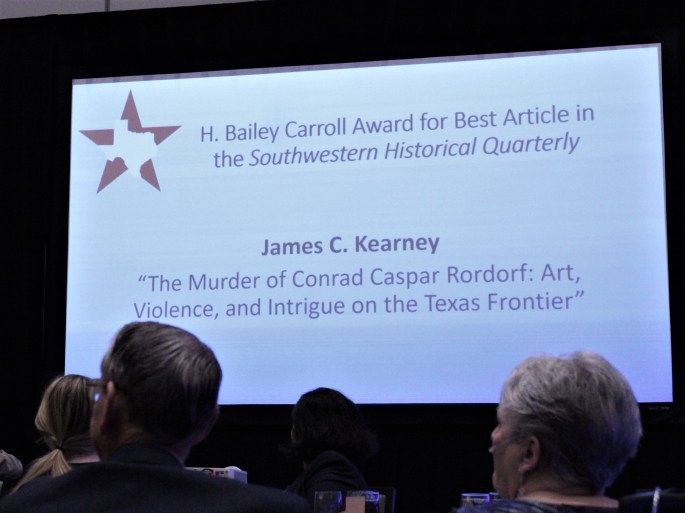
I was pleased and honored to receive the H. Bailey Carroll award for the best article in the Southwestern Historical Quarterly for 2019.  The Swiss-German artist Conrad Caspar Rordorf was killed in a shoot-out at Nassau Plantation in the fall of 1847. Because he was so well-known at the time, his murder and the circumstances that surrounded it were quite sensational in their own right. But his murder also had other improbable outcomes, all of which are explored in the article.   

A New Horse Barn and tack room for the ranch

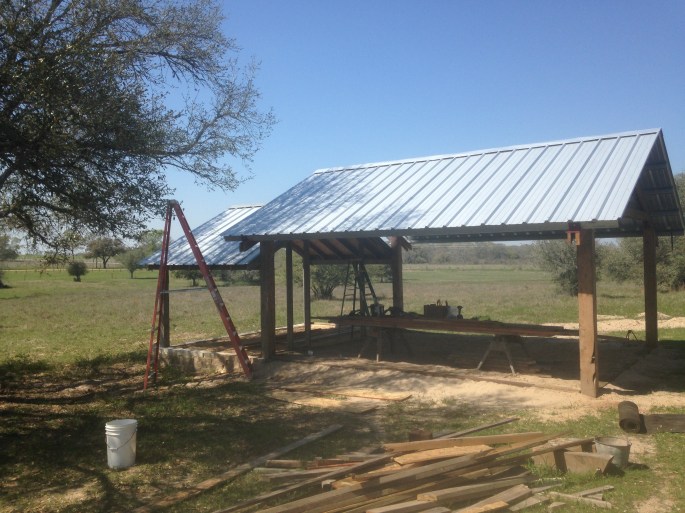
My son Will Kearney is building a new horse barn/shed with tack room for the ranch. We have a barn with tack room at the Home Place ranch, but we moved the horses to the big ranch several years ago and they have been without a barn since then. The trusses and support posts all come from wood harvested from the ranch.  The horses pretty much stay out in the weather all year round but I am sure they will appreciate their own shelter in the future. we have quite a collection of historic saddles, including an original Sam Stagg saddle from the 1870s. We also have three Paulsen saddles from the twenties and thirties, which are highly prized by collectors.  With the new tack room we will have a great place to store and display them.

Making venison sausage at the ranch

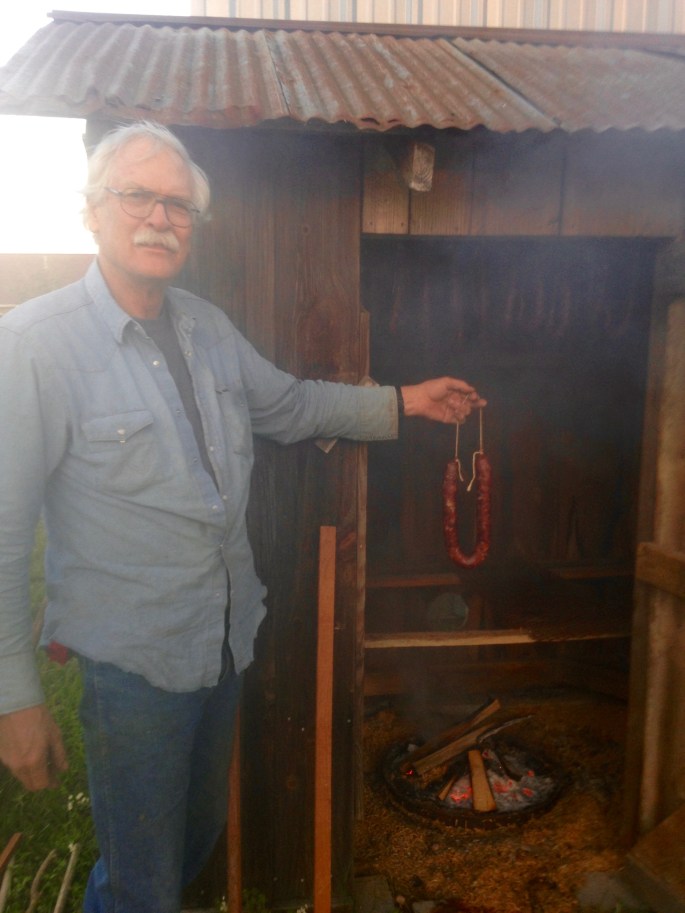
Winter means sausage making time at the ranch.  This year we were a little later than usual, but a good dry, cool norther blew in, giving us a spell of perfect weather to process and smoke the sausage. We usually mix the venison with pork, other wise it would turn out too dry.  It is quite a process to cut up, grind, spice, stuff, ties off and package a hundred pounds of sausage meat, but this year my brother John helped my son Will and I do to the stuffing part, a big help. We only use post oak wood to smoke, and that is the case for most people around thus part of the state.  The wood has a wonderful delicate flavor. We cold smoke for four to six hours, and only for flavor. Sausage like this cannot be purchased commercially because of government regulations. This year’s batch turned out perfect. Half we seasoned with salt, garlic, and black pepper. The other half we spiced up with with ground smoked and dried peppers that we grew and prepared ourselves.

For a short slide show, check out the following link:  https://utexas.box.com/s/xh41m19pc8n56jziskbsmx9dxx1ac31k


Thanksgiving 2017

We had a wonderful gathering for Thanksgiving 2017 at the ranch.  All the kids and their families were in attendance. Many of Paulina’s brothers and sisters (and families) were also able to attend. The weather was picture-perfect. We cooked three turkeys on the smoker and decided to eat outside under our new pavilion, which can serve double service as an outside living room. For a slideshow, click on the following link or copy and paste in your browser:

https://utexas.box.com/s/21dalxsses3vdc1o5g3cp4ybthj9ok3j


Anthology of Texas German Literature

Texas Germans produced an astounding body of literature in the 19th century that embraced all genres and which, if it were stacked up in a piles side by side, would exceed the amount produced in English. In other words, a shadow Texas literature exists that has almost been entirely forgotten. I and several of my colleagues are trying to give voice to this ‘forgotten’ Texas literature through contemporary translations. I am happy to announce that I recently concluded an agreement with Steve Davis, curator of the literary section of the Bill Wittliff Collection at Texas State University in San Marcos, to produce an anthology of Texas German Literature for for a proposed series to be called the “Wittliff Series of Southwestern Literature.”  I have also recently completed an annotated translation of W.A. Trenckmann’s novel, Die Lateiner am Possum Creek [The Lateiner of Possum Creek; a Texas Story]. This is the only true Civil War Home Front novel in either language produced by a contemporary and, for this reason alone, has literary significance. It is a true window into the trials and hardships of the home front years and of the ethical dilemma faced by those who opposed the war but were forced by the conscription laws into military service. For more on this novel, see the tab “Books in Progress.” Texas A&M Press, coincidentally, will be bringing out an updated and annotated translation of W.A. Trenckmann’s memoirs, edited by Drs. Walter Kamphoepner and Walter Buenger, in the near future.

Hurricane Harvey

Hurricane Harvey was for us a major rain and wind event. We received over 30 inches of rain (see water trough in picture) and we endured sustained gale force winds for over forty-eight hours.  Our chief worry was possible environmental damage (erosion, felled trees) resulting from the extraordinary large amounts of rainfall and the unrelenting winds. When the very slow moving storm finally passed, a quick inspection showed that we had suffered very little damage. The rain, although copious, had been spread out over 72 hours and everywhere I looked the runoff water was running clear suggesting very little erosion.  A few trees had fallen here and there including a couple of valued pecan trees but other than that we actually were net beneficiaries from the rainfall because in the weeks prior to the storm it had become very dry.  For a slide show, click below:

https://utexas.box.com/s/9ts6m2zlk9bmxn882l51mfyreyqyupxe