Course Description:
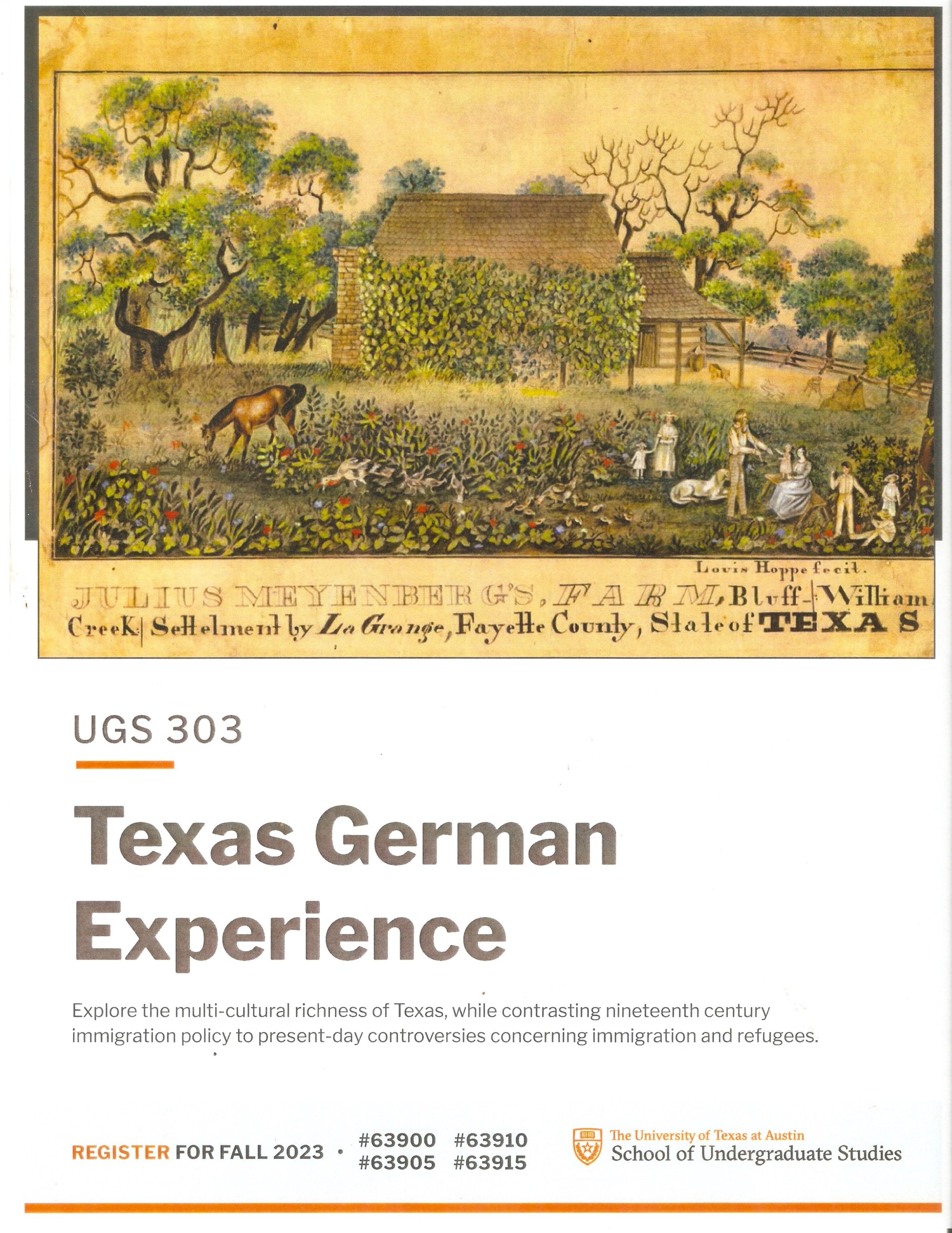
Texas is a colorful tapestry of many nationalities and ethnic groups, each contributing in their own way to the rich diversity of Texas that we should all celebrate. In the nineteenth century waves of immigrants from several Central and Northern European countries altered the demographics of Texas significantly while accelerating both economic and cultural development of the republic and (later) state. German immigrants formed by far the largest component of this migration. Painted churches, dance halls, sausage festivals, etc., still speak to the rich popular culture created by these immigrants in large swaths of Texas while, amazingly, pockets of bilingualism still survive after several generations. The German immigrants also bequeathed a substantial cultural legacy to the state in literature, music, and material culture. Fascinating cultural fusions arose while novel and improbable ethnic redefinitions took shape as these immigrants interacted with other ethnic groups — Hispanic, African, Czech, and Anglo. Many German immigrants championed progressive political and social attitudes current in Europe that they transferred to their new Texas home: free public education for both men and women, support for the arts, concern for the environment, sustainable agriculture, and so forth. Other attitudes led to serious conflict, especially during the Civil War, since many of the immigrants openly opposed secession and/or slavery. Their generally more enlightened attitude about Native Americans also offers a bright spot in an otherwise sordid narrative of displacement, cultural extinction, and ethnic cleansing. The much-lauded but still controversial German/Comanche Peace treaty of 1847 is emblematic of this contrast. This course will examine all these topics while contrasting nineteenth century immigration policy to present-day controversies concerning immigration and refugees.
Disciplines:
History: The primary discipline is history. The course will examine the historical forces at play on both sides of the Atlantic in the nineteenth century and present the relevant facts that led millions of Germans to abandon their homeland and emigrate to the New World and, for many thousands, to choose Texas as their final destination.
Literature: Texas Germans produced a rich literature that embraced all genres. This class will read selections in translation from Friedrich Armand Strubberg’s novel Friedrichsburg (1867), W.A. Trenckmann’s Die Lateiner am Possum Creek (1908) as well as selected poems by Johannes Romberg and Hofmann von Fallersleben. The one novel offers insight into the dramatic story of the Society for the Protection of German Emigrants in Texas — Adelsverein in shorthand — and its effort to settle a land grant on the Texas frontier in the 1840s. The other novel addresses the hard choices faced by German immigrants during the Civil War in Texas. The class will also look at readings that examine the Texas German experience from the woman’s point of view: the letters of Amanda Fallier von Rosenberg, the reminiscences of Ottile Fuchs Goeth and the novels of Clara Matthaei. A full class period has been set aside for this exercise. (See short syllabus, class 22)
Linguistics: This is a minor emphasis, but language is always central to immigration studies. An entirely new German dialect took shape in Texas that embraced nearly 100,000 speakers at its height. This happened nowhere else in the United States and has fascinated generations of scholars. Utilizing the expertise of either Dr. Hans Boas and/or Dr. Marc Pierce of the Department of Germanic Studies at UT, we will spend at least one class period examining the birth and death of Texas German but approaching this in the wider context of the role of language in general for the politics of immigration.
Flags: Writing & Cultural Diversity
Writing Flag courses are designed to give students experience with writing in an academic discipline. In this class, you can expect to write regularly during the semester, complete substantial writing projects, and receive feedback from your TA and from me to help you improve your writing. You will also have the opportunity to revise assignments, and you may be asked to read and discuss your peers’ work. You should therefore expect a substantial portion of your grade to come from your written work. Writing Flag classes meet the Core Communications objectives of Critical Thinking, Communication, Teamwork, and Personal Responsibility, established by the Texas Higher Education Coordinating Board.
Cultural diversity: Texas Germans were one of many ethnic groups which contributed to the rich cultural and ethnic diversity of the state. Importantly, by examining the past, students will be given context and perspective with which to confront more intelligently current and future challenges regarding immigration issues.
Readings
- Trenckmann, W.A. (author) and James C. Kearney (editor), The Forty-Eighters on Possum Creek: A Texas Civil War Story, ISBN 978-1933337845 (provided in Canvas)
- Various other readings, which will be made available as PDFs in the class modules in Canvas.
 jamesckearney.com