
I met Thomas Meinecke ten years ago when he gave a guest lecture at the University of Texas at Austin. We have since become friends. He has visited me here at the ranch and I have done trips with him in the Texas Hill Country where many thousands of Germans settled in the 19th century under the auspices of the Society for the Protection of German Emigrants in Texas, or Adelsverein in shorthand. Meinecke is a curious and intelligent man with an irrepressible energy that leads him to combine his wide-ranging interests into artistic creations that present unusual and sometimes startling literary and musical combinations. And in this regard, I mention that he is not only a prominent literary figure in Germany but a well-known musician and radio personality as well with his own band, F.S.K. (Freiwillige Selbstkontrolle) of many years duration. The band’s musical approach is similar to his literary approach in that it is experimental and diverse, blending different genres and influences, and this includes such improbable combinations as Punk Rock and Texas Polka music, which first caught Meinecke’s interest in the 1980s.
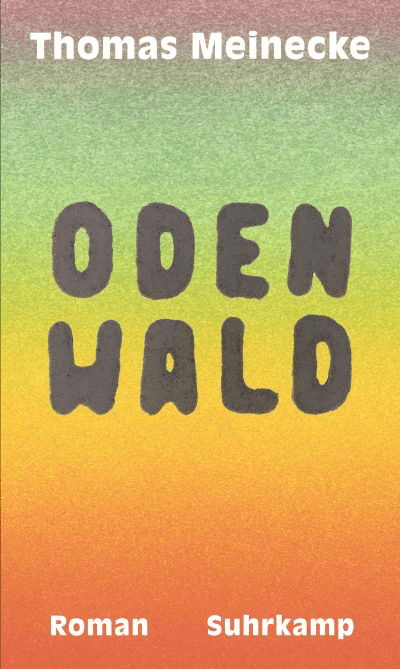
The story of German immigration in Texas, which is my academic specialty, has also captured the attention of Meinecke. In 2015 I showed Meinecke the abandoned site of the German communistic commune Bettina in Llano County. The commune, founded in 1847 by a group of about forty idealistic fraternity brothers from the University of Darmstadt, was named “Bettin” in honor of Bettina von Arnim, the wife of the German Romantic poet Achin von Arnim and a noteworthy literary and cultural figure in her own right. Meinecke wove the saga of the Bettina commune into his novel Selbst (Suhrkamp, 2016) and the larger story of the Adelsverein, with special emphasis on the von Leiningen family into his new novel Odenwald (Suhrkamp, 2024), and, interestingly, I appear in both novels as myself and as a resident expert on Texas German matters.
Although both books are classified as novels, this is somewhat problematic as several critics have been quick to point out. His books are more the literary equivalents of artistic collages that combine dissimilar and seemingly unrelated colors, representations, etc. into an artistic whole. And thus, in Meinecke one finds differing storylines set in different times and places combined with factual reports and a shifting perspective with little in the way of a conventional plot or storyline. Very avant garde and experimental, just like his music. One critic suggested my function in the novel is as a kind of central unifier to all these diverse elements but, be that as it may, I am flattered to play a role even though I am not quite sure what it is.
Posted march 15, 2025
 jamesckearney.com