
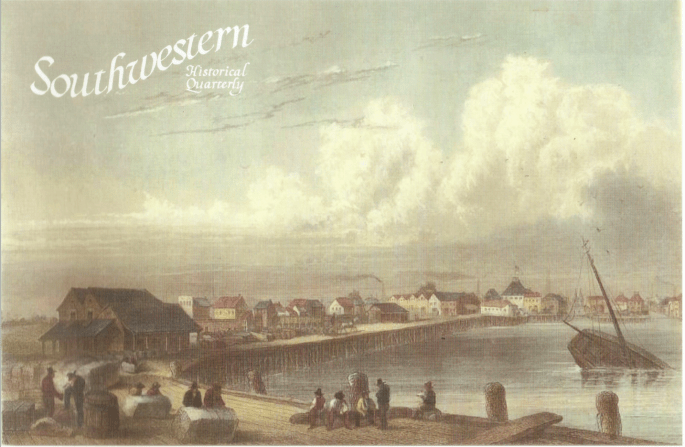
“The Murder of Conrad Caspar Rordorf: Art, Violence, and Intrigue on the Texas Frontier” Southwestern Historical Quarterly, Vol. 123, No. 1 (July 2019), 1-30.
In 2010, as a fundraiser, the Texas State Historical Association auctioned an 1851 painting of a Hill Country grist mill by the Texas German artist Hermann Lungkwitz. The painting fetched over $100,000; an extraordinary sum that underscores the important role European immigrant artists played in the visual history of mid-nineteenth-century Texas and the appreciation they now enjoy among art historians, serious collectors, and the general public, alike. Hermann Lungkwitz (1813-1891), Lungkwitz’s brother-in-law, Richard Petri (1824-1857), and Carl von Iwonski (1830-1912) count as the “big three” of Texas German artists. Theodor Gentilz (1830-1912), a Frenchman recruited as a surveyor by Henri Castro for his Alsatian colony west of San Antonio in 1842, rounds out the group of important European artists on the Texas frontier.
To this list, however, posterity might well have added another name, the Swiss artist Conrad Caspar Rordorf (1800-1847), had not a tragedy played out at Nassau Plantation in northern Fayette County in October 1847 that cost the artist both his life and artistic legacy, at least as it relates to Texas. This is because two sketchbooks containing forty-five drawings of (mainly) Texas Hill Country scenes disappeared in the wake of the shooting and their whereabouts remains a mystery to this day. Only one of Rordorf’s Texas’ works is known with certainty to have survived, the Panorama der Stadt Neu-Braunfels (Panorama of the City of New Braunfels) There is tantalizing evidence, however, that one and possibly three of his renderings of Texas cities appeared as uncredited prints in the 1856/57 editions of the popular German language monthly, Meyer’s Universum, and that at least five Hill Country landscapes also survived as illustrations under false attribution in an adventure novel written by Friedrich Armand Strubberg (also known as Dr. Schubbert) in 1858. These surviving works give us a taste of what was lost with Rordorf’s untimely death in 1847.
The effects of Rordorf’s murder extended beyond art, however. The circumstances of his death inflamed a growing anti-immigrant (specifically anti-German) sentiment among a faction of the Texas political establishment, which had found a vociferous advocate in James Mayfield, ex-secretary of state during the Lamar Administration, former legislator, lawyer, and land speculator. The shoot-out also accelerated the disengagement of the Society for the Protection of German Emigrants in Texas — Adelsverein in shorthand — from its ambitious colonization efforts in the Texas Hill Country with significant economic and demographic consequences for the state, a chapter that has never been thoroughly explored in the literature about the organization. And the ramifications of the shoot-out did not end there. Rordorf’s death at Nassau Plantation also led directly to another spectacular shoot-out on the streets of La Grange in July 1849 between former Texas secretary of state James Mayfield and a notorious rowdy, Absalom Bostick. The affair, which created a sensation across the state because of Mayfield’s prominence, exposed, in a bizarre turn of events, the largest criminal conspiracy to surface in Texas up to that point. The Rordorf story, consequently, is worth revisiting on several counts.
I was very pleased when the following year the article won the H. Bailey Carroll Award from the Texas State Historical Association for the best article in the Quarterly for the year 2019. This was especially gratifying because one of the two blind peer reviewers for the original submission had recommended against publication. In his evaluation, he referred me to secondary sources, which I was readily familiar with, when the whole article was based on primary sources, which he was obviously ignorant of. Luckily, the editors ignored his evaluation and relied instead on the second reader whose evaluation was much more favorable.
 jamesckearney.com