
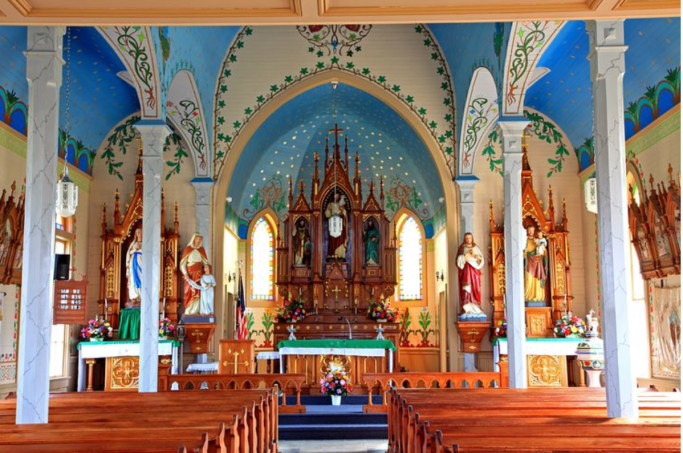
Painted Churches of Texas
For many years the beautiful Painted Churches of Texas remained as hidden gems; unknown with few exceptions to all but the local rural communities they served. In the last fifty years, however, these twenty or so churches – the lists vary — have emerged as one of the more popular tourist destinations in the state, enjoyed and appreciated by an expanding audience that stretches across the ocean. Their colorful and exuberant interiors astonish even as they continue to provide for the spiritual needs of their congregations. They also remind us that Texas is a marvelous tapestry of many nationalities for these churches were built not only to satisfy religious needs, but also to celebrate national identity. Each is clearly associated with one of the four major Central European ethnicities who chose Central Texas as a new home in the nineteenth century: Germans, Czechs, Poles and Wends. A brief overview of the background of these nationalities and their differing religious affiliations will enhance our appreciation for these churches immensely. This is because the churches are also wood and stone testaments to an odyssey to establish new home and community in Texas in the nineteenth century.
The nineteenth century witnessed a massive outflow of emigrants from Central Europe, a large region that included both Germanic and Slavic peoples, and the destination was in the main North America. It is estimated that about eight million Germans alone emigrated to the United States during this century to become the largest immigrant group in the country. Smaller numbers of Czechs, Wends, and Poles (mainly from the then Prussian province of Silesia) joined the massive exodus.
The reasons for this were varied but the underlying cause was clearly overpopulation — a roughly threefold increase occurred in the region from 1750 to 1900 — which led to lack of opportunity in the trades and unequal division of the land in agriculture. There was also a smaller but substantial contingent of political and religious dissenters who joined the exodus, especially after the failed revolutions of 1848 in Germany and the Hapsburg Empire.
Texas became an important chapter in this larger story. So much so that by 1900 it is estimated that about 20% of the White population in Texas had either German or Slavic surnames. Inspired originally by a glowing letter from Friedrich Ernst, who settled on Mill Creek in present Austin County in 1832, a substantial number of Germans chose to settle in Texas rather than the United States even before Texas gained statehood. The South-Central counties of Austin, Fayette, and Colorado became early destinations for these emigrants. The process became self-sustaining and over the course of the nineteenth century many thousands joined their countrymen so that by the turn of the century a three-county area gradually became predominantly German with several communities exclusively German.
The German settlements in the Texas Hill Country followed a different path. Here a corporation of German noblemen played a determinative role. Through its efforts, the corporation, often known in shorthand as the Adelsverein, sponsored about 8,000 Germans in the period from 1844 until 1847. The corporation also founded the towns of New Braunfels (1845) and Fredericksburg (1846), which quickly grew in commercial and cultural significance. But even after the Adelsverein closed shop in 1847, the process it had set in motion continued as settlers wrote letters back home to friends and relatives in the Old Country, encouraging them to emigrate. Compared to their Central Texas brethren, the Hill Country Germans lived in relative isolation as a more or less homogenous ethnicity — a characteristic that persisted well into the twentieth century. Their main divisions were internal, rather than ethnic, as (say) between the educated and not-so-educated, or between the Catholics and Protestants.
The third major destination for Central European immigration concentrated in a large area between Houston and San Antonio bounded roughly by the Colorado River drainage to the east and the Guadalupe River drainage to the west with its major concentrations along the I-10 corridor. It encompassed all or parts of Lee, Colorado, Fayette, Lavaca, DeWitt, and Karnes counties and included the towns of Giddings, La Grange, Fayetteville, Weimar, Schulenburg, Flatonia, Hallettsville, Cuero, Yorktown, and Shiner. The area opened up for large scale immigration only after the Civil War and here the railroads, which began laying their tracks in the 1870s, played a seminal role.
Here, also, the patterns of European immigration differed significantly from the other concentrations to the east and northwest. Rather than more or less homogenous islands of Germanic culture, here we find a patchwork of four main nationalities — Germans, Czechs, Wends, and Poles — with now one and then the other predominating, but always in close proximity one to the other. Thus, to take one example, the little community of Dubina (predominately Czech) is only three miles to the east of Weimar while New Bielau (predominantly German) lies three miles to the south of town, and each rural community erected an impressive church; the one Lutheran, the other Catholic.
Quite interestingly, with two notable exceptions — the St. Stanislaus Catholic Church in Bandera and the St. Mary’s Catholic Church in Fredericksburg — all of the major Painted Churches are located within this third concentration of European immigration, with the majority situated in a tight triangle bounded by Weimar, Flatonia, and Hallettsville, with Schulenburg in the center. Three of these towns were railroad towns. Within this triangle we find the small, unincorporated communities of Ammansville, Dubina, Praha, High Hill, and Moravia, and each has a Painted Church.
Judging by surnames, people of Czech descent form the majority in most of these communities with Germans a close second. The Czechs were strongly Catholic while roughly half the Germans were. It is not surprising, therefore, that all the Painted Churches in this tight area are Catholic, and four of the five are Czech and one German. The four Czech Catholic churches are: Saint John the Baptist Czech Catholic Church at Ammansville, St. Mary’s Church of the Assumption at Praha, the Ascension of Our Lord Catholic Church at Moravia, and St Cyrus and Methodius Catholic Church at Dubina. The lone German church is the Nativity of Mary, Blessed Virgin Catholic Church at High Hill just north of Schulenburg.
Slightly outside this concentration but still within the general area, we find several other Painted Churches that are quite beautiful and reflect other nationalities and religious divisions. Father Leopold Moczygemba established the oldest permanent Polish settlements in the United States near the junction of the San Antonio River and Cibolo Creek in present Karnes County in 1854. Here about 200 Polish immigrants, largely from the then Prussian Province of Silesia, celebrated their first Mass on December 24, 1854 under an oak tree. They named their community Panna Maria (Virgin Mary in Polish). Despite many hardships, the community endured and eventually the settlers erected the impressive Catholic Church of the Immaculate Conception, reputedly the oldest Polish Roman Catholic Church in the U.S., and a must stop on the Painted Churches of Texas tour. Equally impressive is the other Polish Catholic Church at Bandera, the St. Stanislaus Catholic Church.
The Central European immigrants, however, were far from uniform in their religious affiliations. The Czechs, as we have seen, were predominantly Catholic, yet a smaller but significant Protestant minority known as the Moravian Brethren coexisted in the Czech communities. The Brethren had their roots in the Bohemian Reformation in the 15th century which turned the two Czech provinces of Moravia and Bohemia largely Protestant. After the momentous Battle of White Mountain in 1622, however, the two Czech provinces were compelled to revert to Catholicism. Henceforth, Czech Protestantism survived underground for generations as the Moravian Brethren, a fascinating story in itself. Scattered among the Czech settlements in Texas, one finds echoes of this compelling story in five Moravian Brethren churches. One of these, the Wesley Brethren Church located between Round Top and Brenham, counts as a Painted Church.
We conclude our discussion with a look at the Wendish Lutheran Church, which is located in the little community of Serbin to the southeast of Giddings in Lee County. The Wends, a Slavic people who existed as an island in a Germanic sea southeast of Berlin, emigrated in large numbers in the nineteenth century to escape religious persecution. They were nearly all bilingual, speaking their native Sorbian language among themselves but always conducting their church services in German. When the King of Prussia ordered the two Protestant denominations in his territory, the Lutheran and Reformed churches, to unite in 1817, forming the Prussian Union of Churches, the forced unification led to a schism of the Old Lutherans, and chief among those who rejected the unification were the Wends.
Facing persecution and imprisonment, many thousands chose to emigrate rather than adopt the liturgy of the Reformed Lutheran Church, and they chose two overseas destinations: Australia and Texas. In Texas they settled mainly in Lee County (county seat Giddings) and parts of northwestern Fayette and southeastern Bastrop counties. Here they felt free to practice their conservative form of Lutheranism openly. The little community of Serbin became their anchor and here they built St. Paul’s Lutheran Church, the only Lutheran Church of either branch among the Painted Churches.
To wind up this short overview, we pose the question, what was the impulse that gave rise to the beautiful Painted Churches, churches that in many cases seem beyond the capabilities and resources of the small rural communities that they served? It is hard to avoid the conclusion that within this region of South-Central Texas with its patchwork of Central European nationalities, a kind of friendly but creative competition arose to advertise and celebrate both nationality and religious identity through the ornamentation and craftsmanship of their churches. Whether Protestant or Catholic, the churches and their grounds, which often included spacious halls well-suited to both religious and secular events, became the focus of community life for the new immigrants, satisfying religious needs even as they advertised and solidified ethnic identity. What better way to impress?
Each year, on August 15, thousands descend on the small community of Praha (population 21) for the annual Prazska Pout (Praha Picnic). The celebration begins with a Polka Mass in the St. Mary’s Catholic Church, considered by many to be the Crown Jewel of the Painted Churches. Thereafter, the beer stands open and the polka bands strike up. Throngs of celebrants, men women and children of all ages, adjourn to the nearby hall for a fried chicken and stew lunch while others enjoy cake walks, bingo, and dancing., and the festivities last well until the midnight hour. The celebration is no less than a pilgrimage for these the children, grandchildren, and now great-grandchildren of the original Czech immigrants, families long since scattered to the four winds. Here they celebrate and renew both their faith and their shared heritage. This in a nutshell is what the Painted Churches are about.
James Kearney (2022)
 jamesckearney.com