
Land policy and Texas Identity; a Study in Texas Exceptionalism

Land policy and Texas Identity; a Study in Texas Exceptionalism
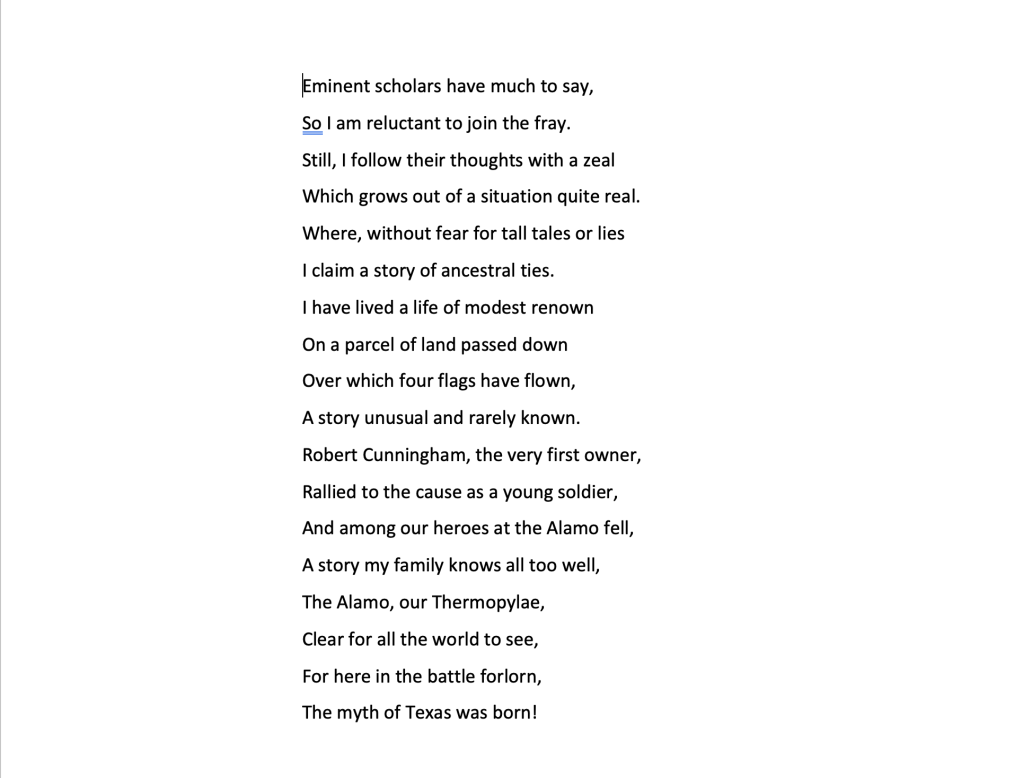
As good Texans we all know we are different — that is a given — but exactly how to define what it is that makes us different has proved elusive and contentious. This being said, and asking forbearance for my poor rhymes, I am often struck by the the derivative nature of much of the commentary on Texas exceptionalism; commentary that often fails to resonate with my own experience. It is important to note that I am not a weekend rancher. Agriculture is my bread and butter as it was for my pioneer ancestors before me on both sides. I know the business inside and out, understand how all the pieces fit together, and am aware of how ranching practices differ from one area of the country to the next. I have also had a foot in the academic world but that is another story. When I shed my academic robes and put on my cowboy hat and speak with fellow ranchers in other Western states as one rancher to another, comparing experiences, the discussion always circles back to something more concrete and close-at-hand that seems to be missing from much of the academic discussions about Texas particularism, namely the way land is owned in Texas, how this differs from state to state, and the effect this difference has exerted, and continues to exert, on those basic attitudes that we and others associate with Texas and Texans.
To be sure, ranching is but one aspect of Texas — and an ever-diminishing aspect at that — but a closer look into it, I believe, can offer a deeper insight into the question at hand. As an example of this tendency to frame the discussion of Texas exceptionalism in derivative terms, I note a lecture by Dr. Sam Haynes entitled, “Unbecoming Southern: The Roots of Texas Exceptionalism,” (2016) which has been posted online. He begins by discussing in depth the popular notion that Texas is the place where the Old South confronted the American West and that out of this collision a new and distinctive identity has emerged. After introducing the idea and acknowledging its appeal, Dr. Haynes goes on to debunk it as the root cause of Texas exceptionalism. He then introduces his own thesis according to which shrewd businessmen and greedy promoters, beginning with the Texas Centennial celebration of 1936, began actively cultivating tourism to the state by shamelessly trading on the salient aspects of Texas history, like cowboys, Indians, Texas rangers, the Alamo, etc., while underplaying or completely ignoring the less savory aspects like slavery and ethnic cleansing of the Native American populations. The resulting image they crafted which often has very little to do with historical accuracy, has become the clichéd image of Texas, designed to lure business and tourists alike, but ultimately seeping into the collective Texas consciousness: the huckster’s tall tale has morphed into historical reality for the average Texas on the street.
All this is very interesting, and I do not wish to dispute any of the central tenants of his argument. Still, returning to the question of land, I try to recall if in any of the conversations with my fellow ranchers from Western states about our respective ranching practices ever touched upon Texas boosterism as an essential difference. The answer is ‘no,’ but what did emerge time after time is that these ranchers for the most part operate and exist in partnership with the Federal government, or, more precisely, some agency or combination of agencies of the federal government such as the Bureau of Land Management (BLM), the National Forest Service (NFS), or the Fish and Wildlife Service (FWS), and that this relationship resembles an unhappy marriage: too much at stake to get a divorce; but too emotionally barren to be a happy union. In contrast, Texas ranchers have little or no traffic with any agencies of the federal government; indeed, Texas ranchers enjoy a freedom from governmental involvement at all levels that many in the West are unaware of and find hard to believe.[*] How did that come about?
So here a little background. When Texas renounced its independence and voluntarily entered the Union in 1845, it precipitated a war with Mexico since Mexico still considered Texas to be a province in revolt that it fully intended to bring back into the fold. The war ended with the Treaty of Guadalupe Hidalgo (1848), an utter disaster for Mexico since it lost over 50% of its territory as a consequence. Accordingly, Mexico ceded to the United States all or part of the present-day states of, California, Nevada, Utah, New Mexico, most of Arizona and Colorado, and parts of Oklahoma, Kansas, and Wyoming. These lands collectively are known as the Mexican Cession. The treaty also formalized the U.S. acquisition of Texas, although its annexation had already occurred in 1845.
The exact boundaries of Texas, however, had not been agreed upon in 1845. The subsequent Compromise of 1850, designed in the first instance to defuse intense sectional conflict over the expansion of slavery, had a secondary effect of defining our boundaries once and for all while solidifying the unique status of Texas as the only state from the Mexican Cession to retain ownership and control over its own public lands. All the other states created from Mexican territory became federal property outside the towns and settled area, and to this day the federal government owns and administers millions of acres in the above listed states. By the terms of the treaty, Texas gave up what it understood as its right to extend slavery westward to California — a bitter pill for the slaveholding class to swallow — but that is another story. To resolve the border dispute, the state relinquished its claim to parts of present New Mexico and Colorado in exchange for ten million dollars to defray its public debt and the right to do as it wished with its public lands.
Thus, the Compromise of 1850 set Texas apart from other former Mexican territories absorbed by the United States. Henceforth, the Federal government had no say in what Texas and Texans did with their land, and this had profound consequences for agriculture, for business, and for the that bundle of Texan attitudes and sensibilities that we call Texas Particularism.
It is perplexing to me that the way Texans own land has been almost entirely overlooked. It is such an obvious distinction. Moreover, it is a distinction that applies equally to all Texans whether they live in the Piney Wood to the East, the Chihuahuan desert to the west, or the High Plains to the North, and pronounced regional differences have always been the fly in the ointment for many learned debates on the subject. Why has such an obvious and uniform distinction been overlooked? Who knows, but by any measure it is an egregious oversight.
let me now take a deeper dive into ranching practices in the Western States and ranching in Texas to illustrate what federal v. private ownership means at the grass root level. The STS Ranch, of which I am very familiar, is a very large operation in Northern Arizona. Sprawling over 200,000 acres, the ranch has its headquarters in the Kit Carson National Forest south of Winslow and west of Flagstaff, AZ. From there it stretches down into the desert country surrounding Crater National Monument. Of the +/- 200,000 acres, only about 5,000 acres is deeded, that is, owned fee simple by the owners; the rest is held and managed under long term lease (ninety-nine years), with the lower areas under the control of the Bureau of Land Management (BLM) and higher regions under the oversight of the National Forest Service (NFS). The 5,000 acres of fee simple land, however, controls the water for the entire ranch for it contains a large lake from which water flows by gravity for miles through a series of pipes and canals to service a multitude of water troughs spread out over the rest of the ranch. This is not an uncommon arrangement; in fact, quite normal for the West where a small patch of privately held land with water controls a much larger acreage of federally owned land without water which the ranchers then lease.
There is no equivalent to this arrangement anywhere in Texas, and from the outside looking in, it appears to be a sweet-heart deal: no property taxes to pay; miles of dirt roads with cattle guards and gates; hundreds of miles of fencing, all maintained at public expense. Just the annual maintenance and upkeep of the roads alone would probably exceed the annual gross income of the ranch, which is to say, the taxpayers in New York and Vermont, and every other state, are subsidizing the STS in Arizona. This is not unusual.
There are also other benefits. The rent the ranch pays to the federal government for the use of the land is substantially less than equivalent lease land in Texas where the rate is set by the market place rather than federal bureaucrats. As a landowner and rancher, I am keenly aware of lease arrangements and what they cost. There is no sense here diving into the details, but the bottom line is astonishing: the leaseholders on federal lands typically pay a quarter or less than what leaseholders in Texas pay for equivalent lands, So, we look at these people and say, what a deal; don’t look a gift horse in the mouth.
In contrast to the STS, our ranch, the 88 Ranch, was originally a subsistence farmstead with a little less than fifty acres under cultivation out of the 4,428 acres it originally embraced, the standard size of a league of land issued to a married man of good standing during the colonial period. Once cattle became valuable, however, which took place after the Civil War, it became strictly cattle and has remained so ever since. During this span of 192 years, from 1833 to the present, the only requirement has been, and continues to be, to pay the annual ad valorem tax to the county, which is minimal since the state offers a very generous discount for bona fide agricultural use of the land. Other than this, we have no interaction with federal authority and minimal interaction with state and local authorities. Then too, there is the question of mineral, water, and hunting rights, all of which we own and that contribute substantial cash inflows. Such a degree of fee simple ownership and control of both surface and mineral rights, where no one looks over your shoulder, where you are unbeholden, and where you answer only to yourself is practically unknown outside the state, and especially in the states to the west of Texas. Consequently, many of the ranchers I have spoken to in New Mexico, Arizona, Utah, etc., are envious of Texas and disgruntled by their own situation.
From the Texans point of view, the ranchers in the West have a sweet-heart deal. But to see it from their point of view, there is a massive trade-off for the benefits they enjoy. They put up with federal oversight, reams of red tape, and constant, often unpleasant interaction with the general public, for the public has the absolute right to come and go on public lands in the West as they see fit. In the summer hordes of tourists descend on the national forests, navigate their massive RVs to the deepest recesses of the backcountry, where they unpack all their gadgetry and then mount their ATVs to go careening around the countryside leaving gates open that ought to remain shut, scattering the cattle that need to stay bunched, and driving the wildlife in a panic to their remotest hangouts. In the winter, likewise, hordes of hunters descend on the National Forests to hunt elk and mule deer, and once again, the remote and pristine Ponderosa pine forest reverberate with the sound of guns, motorcycles ,and ATVs ferrying the hunters to and fro, and every year a few head of cattle fall prey to overanxious hunters who cannot tell the difference between an elk and a cow. That does not happen in Texas. One ventures onto private land at his or her own risk.
Thus, many in the West are disgruntled. The Nevada rancher Cliven Bundy has emerged as the poster child and spokesman of this resentment which has coalesced into the so-called Sage Brush Rebellion. His activism, which has gone violent on occasion, has stoked the fires of simmering discontent for those agitating against federal ownership and yearning for privatization similar to what we enjoy in Texas. Just recently, with the Republicans political sweep, Senator Mike Lee (R-Utah) introduced proposals to mandate just that, the divestiture of millions of acres of public lands in Western states as part of federal budget reconciliation legislation. This was to be done through fast-track auctions with little or no public input. These lands include forestlands, grazing areas, recreation sites, culturally sensitive areas, wildlife habitats, and popular public trails.
But these initiatives, to his astonishment, led to a fierce bipartisan backlash once the full implications (and irreversibility) of such legislation began to sink in. With his tail between his legs, the senator then discreetly withdrew his proposal. One has to wonder if Cliven Bundy and his like-minded friends also got a wake-up call. It must have dawned on them that such fast-tracked federal proposals to privatize millions of acres would have left them in the cold for it would not be he and his fellow Sage Brushers who would end up owning the land. Their ranching days would be over for good as billionaires and well-funded private investment groups rushed in to scoop up the land for private hunting preserves and ambitious development schemes.
Texas, in contrast to the West, presented one of the great land giveaways of all time, and as such provides a show case for both the good and the bad for what unfettered private ownership actually means in the raw.[†] Unrestrained boosterism and rampant land speculation in Texas did not begin with the 1936 Centennial celebrations, as Mr. Haynes has intimated; it arrived much earlier and has served as a leitmotif to the history of Texas from the beginning to the present.. It can be dated to the empresario/land grants Moses Austin and his son Stephen negotiated first with the Kingdom of New Spain and subsequently Mexico that enticed Anglo colonists and European immigrants into Tejas with the promise of free land. The system was also revived by Sam Houston during his second term after Texas gained its independence in 1835. But in all cases, it had this in common: the generosity attendant to land grants produced a climate that encouraged land speculation on a massive scale with hordes of speculators, both honorable and unscrupulous, flocking to the state to get their share of the pie.
And a good deal it was. During the colonial period, a married man of good standing could receive for the asking a league of land (4,428 acres or nearly seven square miles of land!). By any measure that is a lot of land, and much more than a single family could possibly farm or use.[‡] In comparison the standard land grant offered by the U.S. government at the time was fifty acres. One can understand why both native Anglos and European immigrants, upon learning of this, chose Texas over the U.S. as a final destination. The result, of course, is that those who managed to obtain a league of land eventually would begin to parcel off their own holdings, which would have been too large to say grace over in any case, and so hundreds of nominally subsistence farmers also became de facto land speculators themselves.
Empresarios (read politically connected and well-heeled land speculators) who managed to secure land grant contracts would themselves be rewarded with vast amounts of bonus lands which they then needed to dispose of in order to recoup their expenses and collect their reward. Stephen F. Austin, of course, was the most successful of the colonial empresarios, and much ink has been devoted to the Old Three Hundred and their contribution to Texas Particularism. Since our land goes back to Austin’s colony, I have a direct connection to this aspect of the story as my feeble poem intimated, but my academic specialty is the Fisher/Miller land grant issued in 1842 during Sam Houston’s second term as President of the Republic.
Houston was faced with three existential fears: threat of reinvasion of Texas by Mexico, which still considered the fledgling republic to be a province in revolt that it fully intended to bring back into the fold, a stifling public debt, and, finally, the threat of hostile Indians on the frontier. Houston thought a jumpstart in immigration to place more bodies in Texas, especially in the vulnerable areas, would be the best way to counter all three of these threats. Of the four grants issued under the new law, three went to European empresarios, namely the Fisher Miller Grant, the Bourgeoisie d’Orvanne grant, and the Henri Castro Grant. The d’Orvanne grant never got off the ground but the other two did, and in so doing added another important strand to the colorful tapestry which is Texas Particularism. How so? These grants combined resulted in massive numbers of Germans and German-speaker from Alsace/Lorraine settling in the Texas Hill Country and. to the west of San Antonio. Their numbers added to the substantial numbers of Germans and Czech immigrants who settled in a cluster of south-central Texas counties and who eventually grew to be majority of the white population in that area while Central Europeans grew to be twenty percent of the total population of Texas by 1900.
The rich ethnic and cultural diversity of Texas — Hispanic, European, Anglo, African, Native American — is, I would argue, also one of the major components of Texas particularism which has been either outright ignored or underweighted in discussions on the subject. Think of the Painted Churches, the musical fusions like Conjunto, Country Blues, Texas swing, Polka music and dance hall culture, the ethnic festivals such as the New Braunfels Wurstfest, the many church festivals such as the annual Praha Festival in Fayette County that are at root ethnic celebrations, etc., etc. But even this is derivative of the way Texas came to own and distribute its public lands since this is what allowed these immigrants to come here in massive numbers to begin with.
Up to now, I have confined my remarks to agriculture, since that is something with which I and my family have generations of first-hand experience. But the way land is owned and viewed in Texas has even more far-reaching consequences for the business climate that has evolved over time in Texas and for the development of infrastructure of the state, and here I am talking about railroads in the first instance. As an incentive, the state of Texas offered the railroads for the railroads twelve sections of land (a section is one square mile) for every mile of track laid. The railroads became the facilitators of growth at all levels. They opened up vast areas of the state to agriculture by offering a economic access to markets. They also became the main sponsors of European immigration after the Civil War since they were required to dispose of the land they were gifted in a timely was, and as a result they sent agents to Scandinavia, to Germany, to Bohemia and Moravia with a combo offer. One price will get you a ticket to Galveston, a train ride to (say) Schulenburg or Shiner, or West or New Sweden, and a nice little 150 acre farm. These two factors, the railroads and immigration, combined to fuel the post war boom years of the 1880s, in which the population doubled in one decade. It has often been argued that cotton drove the post-war boom. Wrong! Derivative! Land – railroads – immigrants — new towns — new farms — more cotton : this is the progression that led to the explosive growth of Texas in the decade of the 1880s. and thereafter.
We should also not forget that Texas parlayed vacant state lands into an impressive state capitol –the most grandiose state capitol in the Union — and also into a world class university, namely my alma mater, the university of which I am now a faculty member, the University of Texas at Austin. The State gave UT millions of acres of land in the Permian Basin which turned out to be one of the great oil plays of all times, making it the richest university in the world! Money talks, but this money, it should not be forgotten, came from the land which came from the Compromise of 1850.
To sum up, the fact of state ownership of public lands as it played out over the decades translated into a legacy of more absolute fee simple ownership than almost any other state in the union, and this in turn forged attitudes concerning the relationship of the individual toward governmental authority, whether at the state or federal level, that are distinctly Texan. Government, stay out of my hair! This reality shaped both Texas agriculture and Texas business from the get-go and continues to do so at the present, and it is a reality that applies uniformly to all the distinct areas of the state. This environment has undeniably fostered economic growth, job creation, and a dynamic real estate market. Texas, as they say, is a great place to do business. But the other side of the coin is that freedom from government intrusion into private property and business operations, has created urban sprawl, unregulated development, and environmental degradation, and regretfully a predatory mindset toward both the environment and human beings. The recent floods in the Texas Hill Country should be a wakeup call to the tragic results of unregulated development, but don’t hold your breath that anything meaningful will change. The Texas mindset is too firmly set. I have dealt with the both the good and the bad that flows from this reality in another essay entitled, “Texas Ugly; Texas Beautiful; A Complementary View of Texas.”
***
I wish to close by suggesting how different Texas would now be had different land policies been in place. Imagine two scenarios: first, that the Spanish and then the Mexican governments had not authorized the empresario system with its generous land giveaways and that instead the respective governments had offered fifty acres to individual Anglos who wished to resettle in Tejas y Coahuila, fifty acres being equivalent to what the U.S. government was offering at the time. Secondly, imagine that Texas had come into the Union under the same terms as all the other states included in the Mexican Cession, namely that the Federal Government took ownership and control of all lands that were not already settled and claimed. This would have encompassed practically all the lands west of present Interstate-35.
And in a spirit of levity, here is how I imagine it to be:


[*] There are a couple of small exceptions to this generalization. The Texas Tick Fever eradication program of the 1920s was a federal/state partnership as was the Brucellosis quarantine program of the 1970s and 1980s.
[†] Robert Cunningham hired on a raft to float goods down the Ohio and Mississippi rivers from Indiana to New Orleans in 1832. He heard about Texas and the Stephen F. Austin grant once in New Orleans. He made his way to Montezuma (present Columbus), married the daughter of a prominent early citizen, Captain Hunt (probably for convenience), and then applied for a league of land at the office of the alcalde in San Felipe. He was awarded a league in Austin’s colony on Skull Creek in present Colorado County in March 1833, part of Austin’s second wave of colonists. A league of land is 4,428 acres or nearly seven square miles of land. That is a lot of land. In comparison the standard land grant offered by the U.S. government at the time was fifty acres. One can understand why many European immigrants, upon learning of this, chose Texas over the U.S. as a final destination.
[‡] To be sure, large slaveholders did set up sizeable plantations up and down the Brazos and Colorado Rivers, but most of these took shape in the late Republican and antebellum statehood periods, and the sizeable plantations they put together were in the main secondary acquisitions to the original land grants.
 jamesckearney.com